
Philippine solar planning guide
Solar Panels for Aircon in the Philippines: How Many Do You Need?
Panel counts for 1 HP to 2.5 HP aircons, why daytime and night use need different setups, what happens in a brownout, and what it costs to go solar.
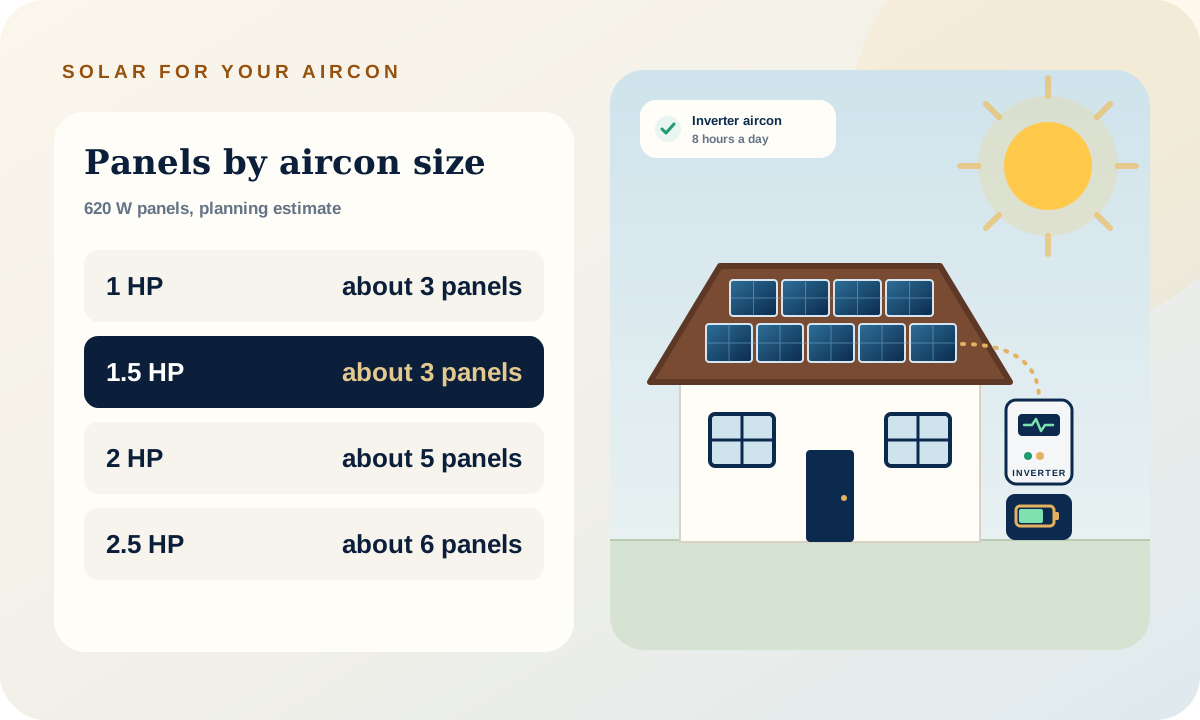
A 1.5 HP inverter aircon running 8 hours a day uses about 150 kWh a month, which takes about 3 solar panels of 620 W to match. A non-inverter unit of the same size needs about 5. In the Philippines, that much electricity is worth roughly ₱2,260 a month at the October 2026 Meralco rate.
The panel count is only half the answer. Panels make power during the day, and many Filipino homes run the aircon at night. A setup that suits a work-from-home office may do little for a bedroom unit used from 10 PM to 6 AM unless you add a battery or use Net Metering. This guide helps you work out which situation is yours before you ask for a quotation.
The short answer
Three things decide what your aircon needs from solar
- Size and typeAn inverter unit needs far fewer panels than a non-inverter unit of the same horsepower.
- Hours and time of dayDaytime use runs directly from the panels. Night use needs a battery, or the grid with Net Metering credits.
- Brownout needsA grid-tied system stops during an outage. A hybrid system can run the aircon only if the circuit, inverter and battery are planned for it.
Solar supplies your whole home, not just the aircon, so these counts are a starting point to add to the rest of your electricity use.
How Many Solar Panels Do You Need for an Aircon?
This table matches a month of aircon use with a month of solar production. It assumes 8 hours a day and 30 days, using Midea Philippines' published usage figures and our package finder's conservative planning formula, about 51 kWh a month from one 620 W panel.
| Aircon | kWh a month | 620 W panels | Electricity value |
|---|---|---|---|
| 1 HPInverter | 113 kWh | About 3 panels | ₱1,700 |
| 1 HPNon-inverter | 180 kWh | About 4 panels | ₱2,710 |
| 1.5 HPInverter | 150 kWh | About 3 panels | ₱2,260 |
| 1.5 HPNon-inverter | 240 kWh | About 5 panels | ₱3,610 |
| 2 HPInverter | 225 kWh | About 5 panels | ₱3,390 |
| 2 HPNon-inverter | 360 kWh | About 8 panels | ₱5,420 |
| 2.5 HPInverter | 300 kWh | About 6 panels | ₱4,520 |
| 2.5 HPNon-inverter | 480 kWh | About 10 panels | ₱7,230 |
Usage figures come from a manufacturer's table and are averages, not a measurement of your unit. One Philippine installer's guide assumes much higher use for a 1.5 HP unit, about 1.2 to 1.5 kWh an hour, which would mean about 6 to 8 panels at the same hours. Hot rooms, low thermostat settings and older units push use higher, so check against your own bill. Electricity value uses the October 2026 Meralco overall rate of ₱15.0615 per kWh, rounded to ₱10. Meralco's rate changes monthly, so use the one on your bill. These are planning figures, not a savings promise.
Solar panel for a 1 HP aircon
A 1 HP inverter unit at 8 hours a day is the smallest load on the table, at about 113 kWh a month or about 3 panels. A non-inverter 1 HP unit uses about 180 kWh, which is about 4 panels. Window-type units are often in this group, so check whether yours is inverter or not before using these numbers.
Solar panel for a 1.5 HP aircon
At about 3 panels for an inverter unit, 1.5 HP sits close to the 1 HP count only because of rounding: 150 kWh is just under what 3 panels make on our formula. Hours matter more than the rounding. Run the same unit 12 hours a day and it uses about 225 kWh, or about 5 panels.
Solar panel for 2 HP and 2.5 HP aircons
A 2 HP inverter unit needs about 5 panels and a 2.5 HP inverter unit about 6. Non-inverter units of these sizes reach about 8 and 10 panels. At this level, roof space becomes part of the decision, so a site assessment is worth doing early.
Work It Out for Your Own Aircon
Horsepower is not the same as electricity use. Two 1.5 HP units can use very different amounts of power depending on their technology, the room and the thermostat setting. To get closer to your real number:
- Find the power inputLook for the input watts on the energy label or spec sheet. An inverter unit usually runs below this figure once the room is cool, so treat it as an upper limit.
- Estimate your hoursCount hours per day for each unit, and note how many fall between morning and late afternoon.
- Calculate monthly kWhInput watts ÷ 1,000 × hours a day × 30 days. A non-inverter unit is close to this. An inverter unit often uses much less, so a figure from your own bill is better.
- Divide by panel outputDivide by about 51 kWh per 620 W panel and round up. Actual output depends on your roof, shading and the weather.
When comparing units, the energy label's CSPF rating helps: a higher CSPF means more cooling for the same electricity. Our package finder can also turn your whole monthly bill into a starting size, and the solar cost and sizing guide explains the other factors.
Daytime vs. Night: When You Use the Aircon Changes the Setup
Matching monthly kWh does not mean the panels power the aircon whenever it is on. This is the question most panel-count guides skip.
| When it runs | What powers it | What that means |
|---|---|---|
| Daytime | Solar panels directly, with the grid or battery filling any gap | The most direct saving, since each kWh you use replaces one you would have bought |
| Night, with a battery | Energy stored during the day | Needs a battery large enough, plus spare panels to recharge it |
| Night, no battery | The grid | With approved Net Metering, daytime exports can earn peso credits against the bill |
Using a battery for night-time aircon
A 1.5 HP inverter unit at 8 hours a night uses about 5 kWh per night on these figures, an average of roughly 0.6 kW. At 51.2 V, a 100 Ah battery holds about 5.1 kWh and a 314 Ah battery about 16 kWh. So one night of aircon would use nearly all of a 100 Ah battery, but about a third of a 314 Ah one. Usable capacity is lower than these nominal figures, and your other evening loads share the same battery, so ask for usable kWh in writing. See solar battery storage for how backup is planned.
Using Net Metering instead
Net Metering lets excess daytime solar earn bill credits, which you can then use against what you buy at night. It is usually less valuable per kWh than using solar directly: Meralco says credits are based on its monthly blended generation cost rather than the full retail rate. Unused credits are banked and carried forward. Compare your options in Net Metering vs. zero export.
Can Solar Run Your Aircon During a Brownout?
It depends on the system, and many people assume wrongly here.
- Grid-tied, no battery: No. Meralco notes that a grid-connected system must stop energizing its lines during an outage, so a standard grid-tied system shuts down even when the sun is out.
- Hybrid with battery: Only if the aircon is on a backed-up circuit and the inverter and battery are sized for it. Most homes back up lights, Wi-Fi, refrigeration and fans, and leave aircons on grid-only circuits because they drain a battery quickly.
- Off-grid: Yes, if designed for it, but aircon greatly increases the panel and battery capacity needed. See off-grid solar systems.
If backup cooling matters, say so at the start. Tell your installer which room, which unit and how long you want it to run. A non-inverter unit is harder to back up, because its compressor draws a brief surge each time it starts, and the inverter must handle that. Hybrid solar systems explains how essential-load circuits work.
Solar Panels for Aircon and Refrigerator
Add each appliance's monthly kWh and divide by panel output. These examples use a refrigerator at 40 kWh a month, which is only an illustration. Use the figure from your own unit's energy label or spec sheet.
| Example load | kWh a month | 620 W panels |
|---|---|---|
| One 1.5 HP inverter aircon + refrigerator | 190 kWh | About 4 panels |
| Two 1.5 HP inverter aircons | 300 kWh | About 6 panels |
| Two 1.5 HP inverter aircons + refrigerator | 340 kWh | About 7 panels |
For most homes, the better starting point is the whole bill rather than a list of appliances. A ₱10,000 bill at the October 2026 rate is about 664 kWh, so a single 1.5 HP inverter unit at 150 kWh would be under a quarter of it. Your aircon may be the biggest single load without being most of the bill.
Can You Install Solar for the Aircon Only?
Not in the way most people picture it. A grid-connected solar system feeds your home's main electrical panel, so its power goes to whatever is running. You can size the system around your aircon use, but you cannot reserve it for one appliance.
A truly separate setup, with its own panels, inverter and battery wired only to the aircon, is an off-grid system. It works without touching your other circuits, but it must carry the whole aircon load by itself, and its output goes unused when the aircon is off. For most homes on the grid, one system serving the whole house makes better use of the panels.
How Much Does Solar for an Aircon Cost?
These are the smallest listed hybrid packages that meet each panel count. Prices include installation labor, standard materials, 12% VAT and a battery, and are as listed on November 6, 2026. They cover the aircon's energy only, not the rest of your home.
| Aircon at 8 hours a day | Panels needed | Smallest listed size | From |
|---|---|---|---|
| 1 HP or 1.5 HP inverter | 3 panels | 2.5 kW (4 panels) | ₱270,000 |
| 1 HP non-inverter | 4 panels | 2.5 kW (4 panels) | ₱270,000 |
| 2 HP inverter or 1.5 HP non-inverter | 5 panels | 3.7 kW (6 panels) | ₱306,000 |
| 2.5 HP inverter | 6 panels | 3.7 kW (6 panels) | ₱306,000 |
| 2 HP non-inverter | 8 panels | 5 kW (8 panels) | ₱444,000 |
| 2.5 HP non-inverter | 10 panels | 6 kW (10 panels) | ₱419,000 |
A larger size can have a lower starting price because the battery differs. The lowest listed 6 kW package has a Dyness DL5.0F 100 Ah (IP20) battery, while our listed 5 kW packages have larger ones. Final prices follow a site assessment.
The hybrid solar price list shows every size and option. Selected packages also have a 36-month, 0% interest option from ₱7,500.00 a month, subject to financing approval; the installment guide explains how that compares with your bill. For payback, see the solar ROI guide. Grid-tied systems without a battery are quoted after assessment.
Should You Upgrade the Aircon Before Going Solar?
If you still run an old non-inverter unit, compare this before sizing. In Midea's table, a 1.5 HP non-inverter unit uses about 240 kWh a month and a standard inverter about 150 kWh. That 90 kWh gap is worth about ₱1,360 a month at the October 2026 rate and about 2 fewer panels on our formula.
A Meralco Power Lab test reported in 2023 found up to 42% lower electricity cost on a 1.0 HP window-type inverter unit, at 25°C and high fan. Your result depends on your unit and habits, and a newer aircon has its own cost, so price both options. An aircon that is already inverter and working well usually stays.
Your Next Step: Get a Size Based on Your Home
Have these ready when you talk to any installer. They turn a rough panel count into a real design:
Bring these to the assessment:
- Your latest electric bill, ideally several months
- Each aircon's horsepower and type
- Hours each unit runs, day and night
- Whether you need cooling during brownouts
- Which other appliances must stay on
- Roof photos and any shading you know of
Bright Horizon Solar (JPMC Engineering Services) is based in Binangonan, Rizal, and has installed 300+ solar systems for homes and businesses across Rizal, Metro Manila, Bulacan, Cavite, Laguna and the wider CALABARZON area. You can see completed projects, such as this 6.20 kWp hybrid solar installation in Caloocan City, Metro Manila, and our Google Maps listing and reviews.
Frequently Asked Questions About Solar Panels and Aircons
How many solar panels do I need for a 1.5 HP aircon?
About 3 panels of 620 W for a 1.5 HP inverter aircon running 8 hours a day, and about 5 for a non-inverter unit. This is an energy match on a conservative planning formula. Your hours, roof and unit can change it.
How many solar panels do I need for a 1 HP aircon?
About 3 panels of 620 W for a 1 HP inverter aircon running 8 hours a day, and about 4 for a non-inverter unit.
Can one solar panel run an aircon?
Not on its own. On our planning formula, one 620 W panel makes about 51 kWh a month, while even a 1 HP inverter aircon at 8 hours a day uses about 113 kWh.
Magkano ang solar panel para sa aircon?
Depende sa laki ng aircon, oras ng gamit at battery. Sa listed packages namin, ang pinakamaliit na hybrid system na may battery ay 4 panels at nagsisimula sa ₱270,000, kasama na ang installation labor, standard materials at 12% VAT. Kinukumpirma ang final price pagkatapos ng site assessment.
Can solar panels run my aircon at night?
Only with a battery. Panels make no power at night, so the aircon runs from stored energy or from the grid. With Net Metering, daytime exports can earn bill credits, but Meralco bases those credits on its monthly blended generation cost, not the full retail rate.
Will my aircon work during a brownout with solar?
A grid-tied system without a battery stops during an outage. A hybrid system can keep the aircon running only if it is on a backed-up circuit and the inverter and battery are sized for it. Most homes back up lights, Wi-Fi, refrigeration and fans instead.
Can I install solar for my aircon only?
A grid-connected system supplies the whole home, not one appliance, so it cannot be reserved for the aircon. You can size it around your aircon use. A separate system that runs only the aircon would be an off-grid setup, which needs its own panels and battery.
Is an inverter aircon better for solar?
Usually, yes. In Midea's table, a 1.5 HP standard inverter uses about 150 kWh a month against 240 kWh for a non-inverter unit at the same hours, which on our formula is about 2 fewer panels.
Will solar bring my bill to zero if I only use it for aircon?
Not necessarily. Your other appliances and fixed bill charges remain, and any aircon use outside solar hours still needs a battery or the grid. A zero electricity bill is not guaranteed.